[01] Magnetic circuit
Explicit magnet reluctance and physical air gap, with a nonlinear iron law. The current material curves and leakage factors are analytical assumptions.
Independent predictive accuracy is not established.

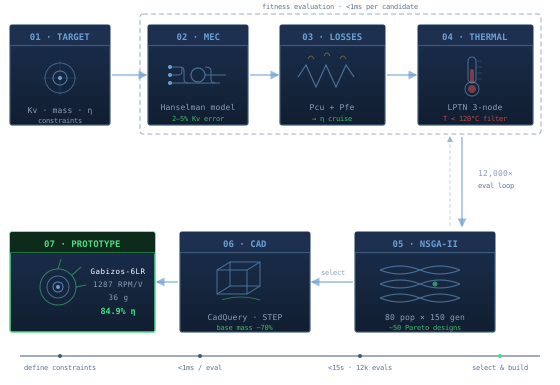
A computational design pipeline for BLDC drone motors. Explore geometries, inspect their magnetic and mechanical limits, then confront the predictions with measurements.
The current release repairs the calculation and CAD pipeline. A new R2 candidate needs independent reference data before its performance can be assessed.
Explicit magnet reluctance and physical air gap, with a nonlinear iron law. The current material curves and leakage factors are analytical assumptions.
Independent predictive accuracy is not established.
Explore dimensions and winding choices against mass, current, slot fill and saturation limits. Numerical convergence and feasibility are checked separately.
A converged search can have no feasible design.
Geometry produces STEP, STL and DXF files. R1 checks stator continuity and nominal component intersections.
Valid CAD still requires manufacturing and mechanical qualification.
The legacy optimization bounds were checked again after the review corrections. The recorded run used 24 candidates over 8 generations, with seed 42.
It produced 0 feasible candidates in 192 evaluations. This is a bounded check of those settings, not evidence that the entire design space is infeasible.
Specify the winding, connection, electrical waveform and load case. Identify material and loss data, compare back-EMF and resistance with an independent reference, then revisit the search bounds.
No current Pareto frontier or new qualified motor is claimed.
292 / 292 recorded software tests passed.
Report recorded at 2026-10-22T10:34:39 (report clock). These checks cover program behavior and numerical invariants. They do not measure motor performance.
R1 contains one connected stator solid and no nominal volumetric interference between the checked assembly components.
The commercial database contains 144 screening comparisons. Internal dimensions and winding are estimated for that dataset.
0 independent references are currently recorded. The status is
NO_INDEPENDENT_REFERENCE.
Bench back-EMF, resistance, mass, torque, losses and temperatures remain to be established.
| Stator | 23 × 10 mm (2310) |
|---|---|
| Configuration | 12N14P outrunner |
| Nominal air gap | 0.20 mm |
| Winding input | 12 turns / tooth, 1 × 0.50 mm |
| Mass estimate | 51.3 g, with allowances |
| Measured performance | Not established |
Mass uses nominal material densities, CAD volumes, analytical copper length, a 3.0 g bearing allowance and 0.5 g consumable allowance. It has not been weighed.
| Scalar-equivalent Kv | 903 RPM/V |
|---|---|
| Tooth flux density | 2.04 T, constraint exceeded |
| Stator yoke / bell | 1.43 / 1.31 T |
| Bare copper slot fill | 36.33%, before insulation |
| Constraint status | Outside legacy design constraints |
Scalar Kv has no identified phase, line or controller convention. The analytical iron law is not supplier characterization. These estimates do not define a rated operating point.
Interested in a technical comparison or a bench protocol? Get in touch to discuss the reference data and the next iteration.
contact@fra142motors.com